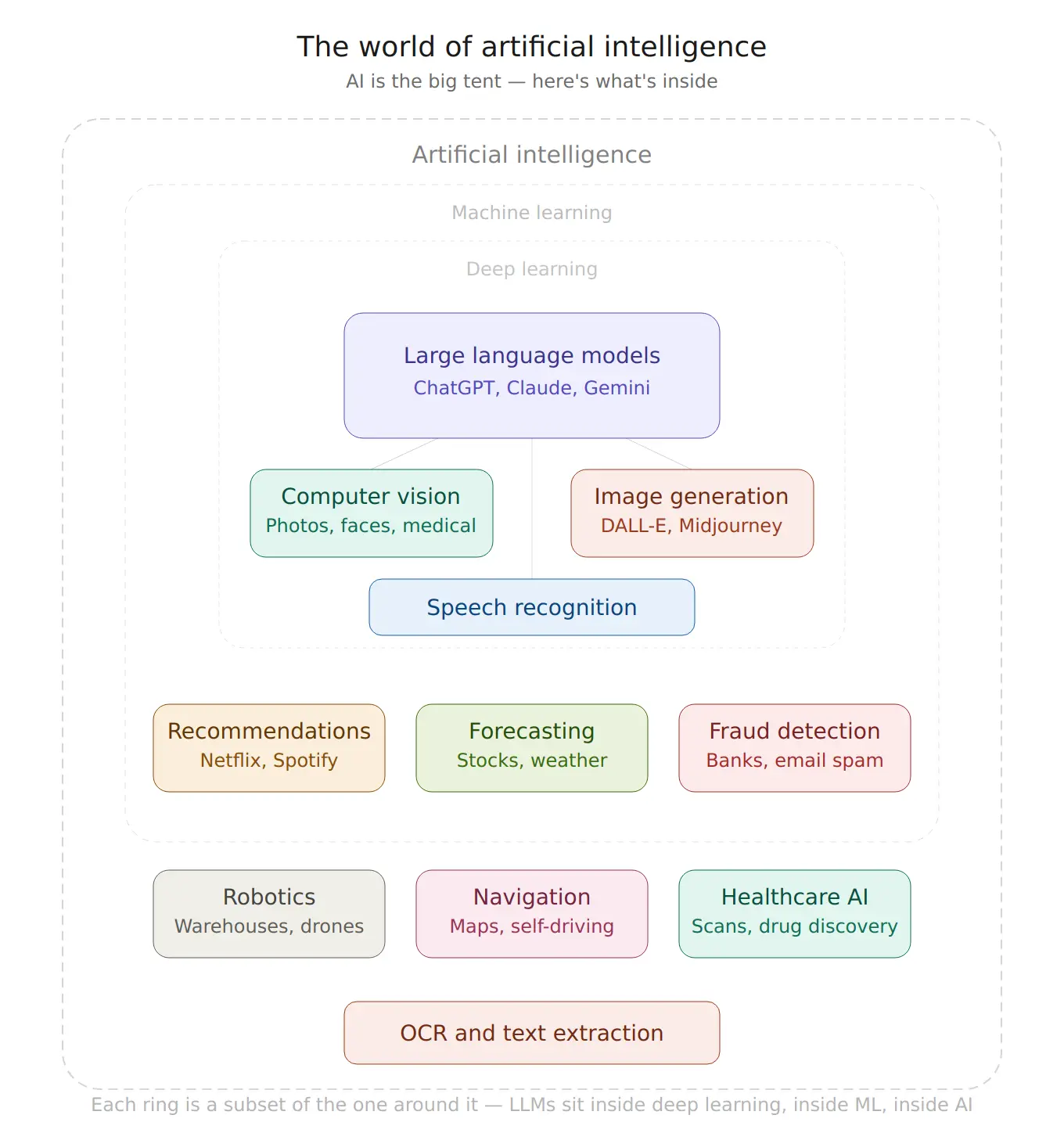
Two years after the LLM gold rush kicked off, the temperature of the conversation has finally come down. Clients ask sharper questions now. Less “how do we get AI into our product” and more “is this thing actually a good fit here.” This post is where I land on that question, after a couple of years of using LLMs in real work.
Where it’s genuinely earned its keep
Drafting and editing
This is the boring but big one. A first draft of an email, a proposal, a meeting summary, a blog post outline, an SOW. The bar for “starting point I can edit” is much lower than the bar for “finished work”, and LLMs clear it easily. I treat this like a fast intern: they get the bones in front of me, I rewrite half of it, total time goes down by ~40%.
Code generation for boilerplate
Anything I’ve written a hundred times. CRUD endpoints, form validation, SQL migrations, Tailwind component scaffolds, boilerplate test cases. The LLM does in seconds and I review/correct. The big win isn’t the typing; it’s never having to go look up the exact incantation for a Laravel migration or a pydantic V2 validator. The model knows; I confirm.
Translating between formats
HL7v2 to FHIR, CSV to a SQL schema, a screenshot of a config to the corresponding YAML, a Postman collection to curl commands. These are tedious mechanical translations where I used to lose hours. Now they’re a paste-and-verify loop.
Reading code I didn’t write
“Explain what this 800-line PHP file is doing” used to be a coffee-and-coding-Sherlock-Holmes exercise. Now it’s a single prompt that gets me 80% of the way there. The remaining 20% is the part where the LLM is wrong about something subtle and I have to actually read carefully, but I’m starting from a vastly better place.
RAG over a client’s knowledge base
This is the one client-facing AI product I’ve actually shipped in 2026: documentation search where the answer cites the source. The stack is in A RAG stack that actually ships. Done right, it’s genuinely useful and well below $0.02 per query.
Where I push back
Customer-facing chatbots for transactional support
The success rate of these in production is still ugly. The wins come from very tightly scoped, retrieval-grounded systems with strict guardrails. Not “here’s an open-ended bot, hope it’s nice to customers.” If the client’s real problem is “we have too few people answering tickets,” I’d rather build a smarter triage queue than ship a bot the customer will end up working around.
“Use AI to summarize our meetings”. Without a clear destination
Meeting summaries are easy to generate and useless if nobody reads them. The actual value is in turning meeting decisions into tickets, action items, or follow-ups that hook into something. Without that pipeline, you’re just generating bullet points in a Notion page nobody opens.
Replacing a developer with Cursor
For a non-technical small business owner the pitch “you don’t need a developer, just use Cursor” is a trap. Cursor is fantastic; it’s also a power tool that produces fast bad code when wielded without judgment. The right move for non-technical owners is still “hire a developer who uses AI tooling correctly,” not “DIY with AI.”
Auto-generated SEO content
I wrote about this in the Sea of Thieves SEO post. LLM-generated “ultimate guide” posts are racing each other to zero. Google’s ranking has visibly started penalizing it. Don’t spend money on this.
The decision framework I actually use
When a client says “can we use AI for X,” I ask three questions in this order:
- Is there an existing tool that already does this? A spreadsheet, a cron job, a SaaS product. If yes, use that. Most AI feature ideas are problems someone already solved with a database.
- What does “wrong” cost? If the LLM is wrong 5% of the time, is that fine (drafting an email) or catastrophic (sending a refund)? If wrong is expensive, you need either retrieval grounding, strict output constraints, or human review. Otherwise don’t ship it.
- Can the value be measured in dollars or hours saved? If yes, build it. If the answer is “well, it’ll feel modern,” we’re building something else.
My current toolbelt
| Use | Tool | Why |
|---|---|---|
| Day-to-day coding | Claude Sonnet in Cursor / Claude Code | Best code reasoning at this writing |
| Long-form writing draft | Claude Opus in the chat UI | Better voice, less generic |
| Quick lookups / one-shot questions | Claude Haiku or Gemini Flash | Faster + cheaper than necessary for these |
| Embedding / RAG pipelines | OpenAI text-embedding-3-small + Cohere rerank | Best price-to-quality ratio |
| Image generation (rarely) | OpenAI or Midjourney | Only for blog hero illustrations |
What I think happens next
The hype curve is bending toward usefulness. The companies that shipped LLM features for the sake of having them are quietly removing them; the ones who built actual workflows around the tools are seeing real productivity gains. By end of 2026 the distinction between “an AI product” and “a software product that happens to use AI internally” will be mostly meaningless. It’s a tool. Use it where it works.
If you’re trying to figure out whether your specific use case is one where AI helps or hurts, that’s a conversation I’m happy to have for free. Drop me a line.